
Bristol County Dissolution of Marriage Records
Bristol County dissolution of marriage records are filed and kept at the Probate and Family Court, which runs three locations across the county in Taunton, Fall River, and New Bedford. If you need to find a divorce case, get a certified copy of a divorce decree, or confirm the status of a filed case, this guide covers how to search records and what to expect when you contact the court.
Bristol County Overview
Bristol County Probate and Family Court
The Bristol County Probate and Family Court handles all dissolution of marriage cases in the county. It is one of the few Probate courts in Massachusetts that runs three active locations. The main office is in Taunton, but residents near Fall River or New Bedford can use those locations as well. All three share the same email and follow the same procedures for records requests.
Staff at any of the three locations can help you look up divorce filings, check case status, and tell you what you need to get a copy. The court also runs a Virtual Registry during set hours each week day. This lets you handle records requests by video call instead of traveling to the courthouse. That option works well if you just need basic info or want to confirm a case number before mailing a copy request.
The court's official website, mass.gov/locations/bristol-probate-and-family-court, has current hours, phone numbers for each session, and links to the forms you need. Check that page if you are unsure which location to contact first.
The Massachusetts Probate system uses a form called the PFC-18 to request copies of court records. You can learn more about that form at the official page for the Probate and Family Court Request for Copies (Form PFC-18). The image below shows what that form looks like.
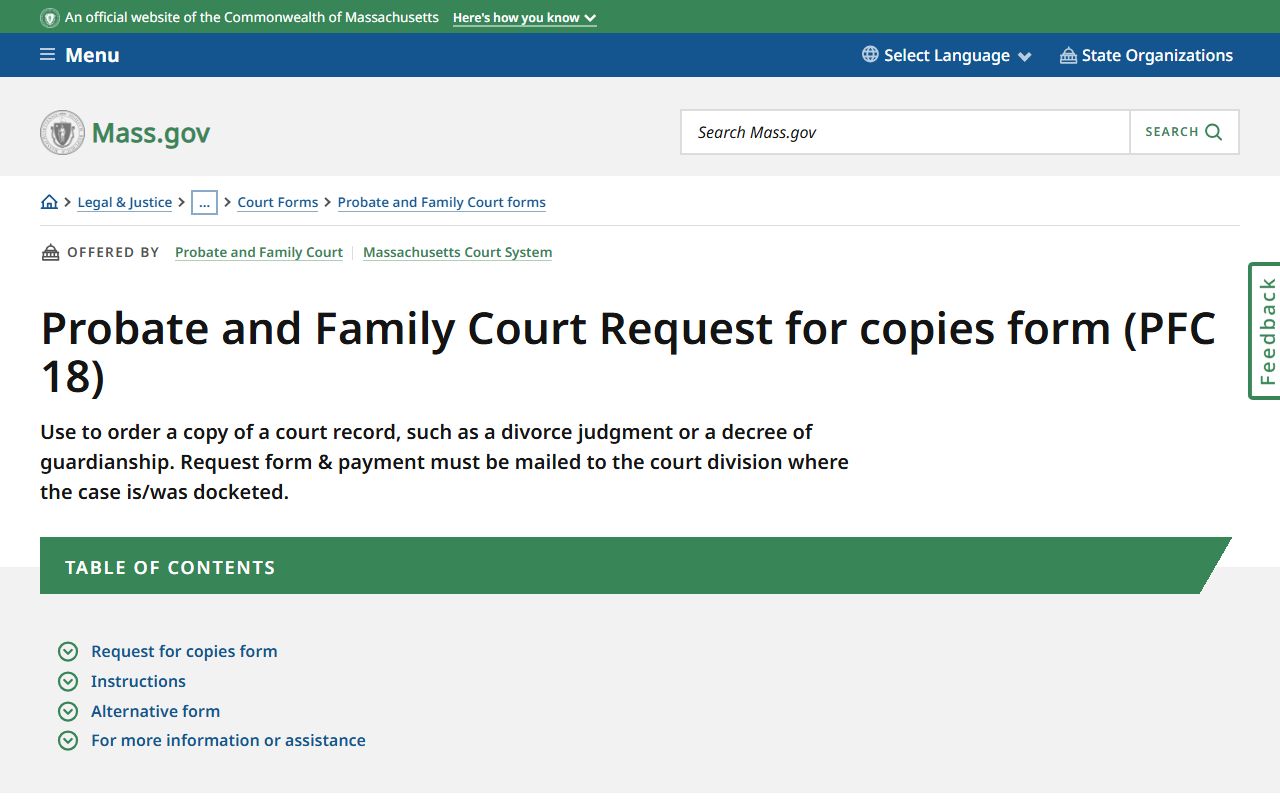
Download the form from the link above, fill it out, and submit it in person, by mail to the Taunton office, or by email to bristolprobate@jud.state.ma.us. The court typically processes copy requests within 5 to 10 business days.
| Court | Bristol County Probate and Family Court |
|---|---|
| Main Office (Taunton) |
40 Broadway, Suite 240 Taunton, MA 02780 |
| Fall River Session |
289 Rock Street Fall River, MA 02720 |
| New Bedford Session |
505 Pleasant Street New Bedford, MA 02740 |
| Phone (Taunton) | (508) 977-6040 / (508) 824-4004 |
| Phone (Fall River) | (508) 672-1751 |
| Phone (New Bedford) | (508) 999-5249 |
| bristolprobate@jud.state.ma.us | |
| Hours | Monday through Friday, 8:30 AM to 4:30 PM |
| Virtual Registry | Monday through Friday, 9:00 AM to 12:00 PM and 2:00 PM to 4:00 PM |
| Website | mass.gov - Bristol Probate Court |
How to Find Bristol County Divorce Records
There are a few ways to search divorce records in Bristol County. The easiest starting point is the state's free online lookup tool. MassCourts lets you search by name or case number and shows basic case details like docket entries, hearing dates, and the current status of a case. Go to masscourts.org and choose the Probate and Family Court to start. Not every detail shows up online, but you can confirm whether a case was filed and get the case number to use in a formal copy request.
If you need the actual documents, such as the judgment of divorce nisi or the separation agreement, you have to contact the court directly. You can do that in person at any of the three Bristol County locations, by mail to the Taunton main office, by email, or through the Virtual Registry. The Virtual Registry runs on Zoom at zoom.us/j/1612606196 or by phone at 1-646-828-7666 (Meeting ID: 1612606196). It is a good option if you have a question before sending a formal request.
To search or request records, you will generally need:
- Full name of one or both spouses at time of filing
- Approximate year the case was filed
- Case or docket number if you have it
- Your own ID if requesting in person
Historical divorce records from before 1952 are not held at the county court. Those records are kept at the Massachusetts State Archives. Call the Archives at (617) 727-2816 or visit their site if you need an older record. The process there is different from requesting records at the county level. More information about accessing historical records is available at mass.gov/how-to/get-access-to-historic-divorce-records.
Fees for Copies and Filing in Bristol County
Bristol County follows the statewide fee schedule used by all Probate and Family Courts in Massachusetts. Certified copies of divorce decrees or judgments cost $20 each. That fee applies no matter which of the three locations you use. You can get plain (uncertified) copies as well, and those cost less, but most agencies and institutions that need proof of your divorce will require a certified copy.
Filing fees for a new case also follow the statewide schedule. A joint petition for dissolution of marriage under M.G.L. c. 208, § 1A costs $215. A complaint for divorce under § 1B costs $280. There are also smaller charges for a surcharge, summons, and citation. If you file online through eFileMA, there is a $22 case initiation fee on top of filing fees.
The court does not accept personal checks. Acceptable payment methods for Bristol County Probate and Family Court are attorney's check, money order, bank certified check, or cashier's check. All payments must be made out to "Commonwealth of Massachusetts." If you mail a records request with Form PFC-18, include your payment with the form. The court will mail your copies to the address you list on the form.
If you cannot afford the filing fees, you can ask for a waiver. File an Affidavit of Indigency with the court. A judge reviews your income and decides if you qualify. The Trial Court Help Line at 1-833-912-6878 can answer basic questions about the fee waiver process and other court procedures. They are available Monday through Friday during court hours.
Bristol County Dissolution of Marriage Process
Dissolution of marriage cases in Bristol County go through the Probate and Family Court under M.G.L. Chapter 208. Every step in the process creates a record that becomes part of the case file. Those records are what people search for when they need proof of a divorce or want to review the terms of an old case.
Before filing, you need to meet the residency rule. Under M.G.L. c. 208, § 5, if the reason for the divorce happened outside Massachusetts, at least one spouse must have lived in the state for one full year before filing. If the grounds arose within Massachusetts, no minimum time applies. You file in Bristol County if you or your spouse lives in one of the 20 towns the court serves.
Massachusetts offers two no-fault options. Under M.G.L. c. 208, § 1A, both spouses file together with a signed separation agreement. This is the joint petition route. Under § 1B, one spouse files alone, citing an irretrievable breakdown of the marriage. Most cases in Bristol County use one of these two paths.
Nisi Period: A Massachusetts divorce does not become final the day the judge signs the order. After the judgment nisi is entered, joint petition cases (1A) wait 120 days and contested cases (1B) wait 90 days before the divorce becomes absolute.
Property division is decided under M.G.L. c. 208, § 34. The court looks at a range of factors including the length of the marriage, each spouse's income and needs, and contributions to the household. The financial statement each party files with the court is automatically impounded under Rule 401 of the Supplemental Probate Court Rules, meaning it is not freely available to the public. Other parts of the case file generally are public record.
Massachusetts has one of the lowest divorce rates in the country, about 1 per 1,000 residents. Even so, Bristol County processes a steady volume of dissolution cases each year across its three court locations.
Alimony decisions in Massachusetts follow M.G.L. c. 208, § 37, which sets caps on the amount and duration of general term alimony based on the length of the marriage. If alimony is ordered, the amount and term will appear in the judgment. That detail becomes part of the public case record, though the underlying financial statements stay impounded.
What Bristol County Divorce Records Contain
A dissolution of marriage case file in Bristol County holds all the papers from start to finish. The first document is either a complaint for divorce or a joint petition, depending on which route the parties took. That document states the grounds, lists both spouses by name, and sets out what the filing party is asking the court to order. All of this becomes a permanent record.
The judgment of divorce nisi is the main document most people need a copy of. It is the court order that officially ends the marriage once the nisi period expires. The judgment includes all the final terms: property division under § 34, child custody arrangements, support orders, and any alimony. If you need proof of your divorce for a legal or financial purpose, you need a certified copy of this document from the court.
Other records in a typical case file include:
- Summons and proof of service
- Separation agreement (if applicable)
- Temporary orders for support or custody
- Hearing notices and continuance orders
- Final judgment of divorce absolute
Most records are open to the public. You do not need to be a party to the case to request copies. Financial statements filed under Rule 401 are the main exception. Those are sealed from public view. If you are not sure what is in a specific file, call the court or use the Virtual Registry to ask before making a formal request. That can save you time and the cost of a copy fee.
Legal Help for Bristol County Residents
Southeastern Massachusetts Legal Services provides free legal help to income-qualified residents in Bristol County. Their phone number is (508) 584-4543. They handle family law matters including divorce and custody. If you do not qualify for free help, they may be able to point you to lower-cost options in the area.
MassLegalHelp at masslegalhelp.org is a good starting point if you plan to file without a lawyer. The site has plain-language guides on how Massachusetts divorce law works, what forms to use, and how to serve papers on the other party. All official Probate and Family Court forms for divorce are free to download at mass.gov/lists/probate-and-family-court-forms-for-divorce. You can fill them out yourself and file at any of the three Bristol County locations.
The Trial Court Help Line at 1-833-912-6878 answers questions about court procedures, forms, and filing steps. It is not legal advice, but it can help you understand what the court expects and what happens at each stage of a case. Staff are available Monday through Friday during regular court hours. If you need help finding a lawyer, the Massachusetts Bar Association referral line at (866) 627-7577 can connect you with a family law attorney in your area.
The state's general guide to getting a copy of a divorce record is at mass.gov/how-to/get-a-copy-of-your-divorce-record. That page covers the difference between certified and plain copies, explains who can request records, and links to the PFC-18 form. If you have already gone through the court's Virtual Registry or tried the online search and still have questions, that page is a useful next step.
Qualifying Cities in Bristol County
Three cities in Bristol County meet the population threshold for their own records pages. All divorce filings for residents of these cities go through the Bristol County Probate and Family Court at one of the three locations above.
Other communities in Bristol County include Acushnet, Attleboro, Berkley, Dartmouth, Dighton, Easton, Fairhaven, Freetown, Mansfield, North Attleboro, Norton, Raynham, Rehoboth, Seekonk, Somerset, Swansea, and Westport. Residents of all these towns file dissolution of marriage cases at the Bristol County Probate and Family Court.
Nearby Counties
Bristol County borders several other Massachusetts counties. If you are not certain which court has jurisdiction over your case, your county of residence at the time of filing is the key factor. Each county has its own Probate and Family Court with its own records.